Ozone Test Chamber

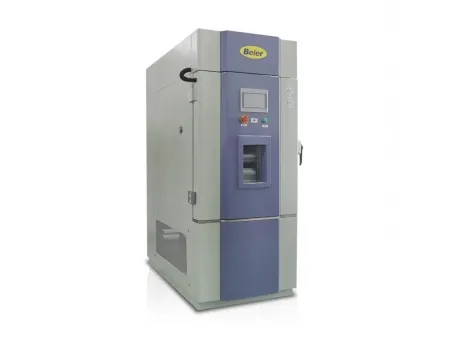
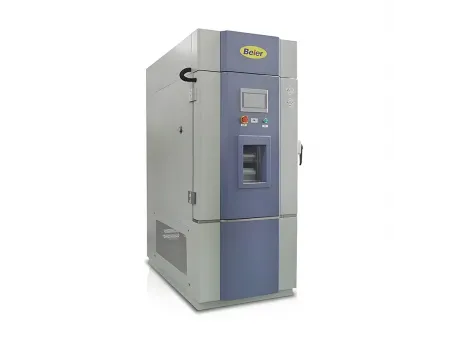
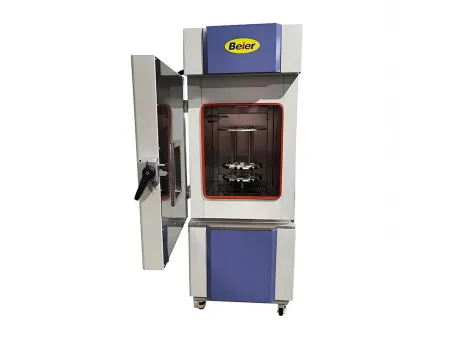

Environmental chamber used for aging test of elastomers and rubber products
- Ozone test chamber is able to perform static endurance test, exposing the samples to sealed air with a certain concentration of ozone and constant temperature.
- Ozone test chamber is also able to perform testing under static strain or continuous dynamic strain, or after interrupting dynamic tensile and static strain. To test, expose the products in a closed, sunlight-free and temperature-controlled environmental test chamber. And then observe the cracks on the test products’ surface, or the changes of other properties to evaluate the ozone resistance of vulcanized rubber.
- Ozone test chamber is equipped with an internal circulation air duct. The ozone concentration, temperature, and humidity are controlled via computer. These ensure uniform airflow parallel to the surface of the specimens, in compliance with international standards.
- Computerized ozone concentration, temperature, and humidity controller offers high integration, LED display, high temperature and humidity resolution, and good reliability.
| Ozone Concentration | 0~500pphm, 0~1000pphm, 100~250ppm | Optional |
| Ozone Measurement Accuracy | ±5% | |
| Working Chamber Dimensions (D x W x H) | 150L, 500 × 500 × 600 mm (Customizable) | |
| Overall Equipment Dimensions (L x W x H) | 1220 × 700 × 1880 mm (including casters, customizable) | |
| Temperature Range | RT 10℃~80℃, -10℃~80℃ | Optional |
| Temperature Deviation | ±2℃ | |
| Relative Humidity | ≤65% RH | |
| Sample Holder Rotating Speed | 2r/min | Optional |
| Sample Holder Stretching Frequency | 0.5Hz | Optional |
| Airflow Velocity | 12~16mm/s | |
| Airflow Rate | 20~70L/min | |
| Ambient Temperature | 10℃~25℃ | |
Control System
The touchscreen intelligent controller is located on the front right side of the test chamber, featuring an embedded industrial control integrated computer (7-inch color touchscreen) with a USB interface for printing test data from a PC. It employs the Beer-Lamber law measurement application software. The integrated ozone concentration, temperature, and humidity controller (with touch-button settings) offer high integration, reliability, LED display, and temperature resolution of 0.1°C, humidity resolution of 0.1% RH, and ozone concentration of 1 ppm. PID setpoint control ensures easy operation.
Humidification Method
Utilizes electric steam humidification controlled by PID-adjusted non-contact solid-state relays.
Water Supply Method
Stainless steel humidifier, water level gauge, water tank.
Gas Flowmeter
Gas flowmeter ensures precise control of gas flow at various levels.
Gas Purification Device
Gas purifier includes an activated carbon absorption, and silica gel drying units.
Satisfies both static tensile testing requirements, ensuring specimen movement adheres to the cycloidal trajectory principle, and dynamic tensile testing. Operation is convenient and reliable.
What method does your ozone test chamber use to detect ozone concentration?
Commonly used methods include electrochemical sensor analysis and ultraviolet (UV) absorption. Our ozone test chambers are equipped with imported ozone analyzers that utilize the advanced UV absorption method to detect ozone concentration. This method offers high accuracy and reliable data, enabling continuous online detection to ensure precise test results!
What are the power requirements for your ozone test chamber?
Our patented product (Invention Patent No. ZL:03150992.4), with a working chamber size of 150L, operates on a 220V power supply.
What is the working principle of your ozone test chamber?
It is equipment designed to test the ozone resistance of materials. Ozone in the air accelerates the aging of materials like rubber and plastics. The ozone aging test chamber simulates an ozone environment to accelerate the evaluation process, helping to understand material durability and ensuring product stability and reliability during long-term use.
What is the size of the working chamber for your ozone test chamber, and can it be customized?
Our standard model, BR-QL150, features a working chamber size of 150L, with dimensions of 500×500×600 mm (D×W×H). Other chamber dimensions can be customized according to customer requirements!
Can the specimen racks equipped in your ozone test chamber support both static and dynamic tensile testing?
Beier Labs is the only manufacturer in China capable of integrating both dynamic and static tensile specimen racks into a single ozone aging test chamber! We achieve this by increasing the equipment size and incorporating independent space, thereby meeting customers' compatibility needs.
I'm unsure what configuration of ozone test chamber my company's product needs. Could you explain the differences?
Requirements for ozone test chambers vary significantly across different industries. Below are the main distinctions in ozone chamber needs for the textile industry (e.g., Luolai), the rubber industry, and the electronics industry (e.g., Gree):
- Textile Industry: Typically requires low ozone concentration, high humidity, a narrow temperature range, and specimen racks suitable for flat samples. Ozone aging tests for textiles usually need lower ozone concentrations (e.g., 10 ppm ~ 50 ppm) but demand more precise humidity control, often requiring relative humidity between 60% and 80%. Humidity significantly impacts the aging speed and manner of textiles, with high humidity accelerating hydrolysis and oxidation of fibers.
- Rubber Industry: Requires high ozone concentration, low humidity, a wide temperature range, and specimen racks suitable for tensile or hanging samples. Ozone resistance tests for rubber materials typically demand higher ozone concentrations (e.g., 50 ppm ~ 1000 ppm) because rubber's ozone resistance is relatively stronger than textiles, necessitating higher concentrations to accelerate the aging process. Rubber samples are often strip-shaped or block-shaped, requiring specimen racks designed for stretching or hanging to simulate stress conditions during actual use.
- Electronics Industry: Requires moderate ozone concentration, moderate humidity, a narrow temperature range, and specimen racks suitable for fixed and powered testing. Ozone resistance test concentrations for electronic components are usually between 20 ppm and 100 ppm. Outer casing materials of electronic components (e.g., plastics, rubber) need to be tested at lower concentrations to evaluate their durability in long-term, low-concentration ozone environments. Humidity requirements for electronic component testing are generally stricter, typically between 40% and 60%, to simulate humidity conditions in actual use environments. High humidity might lead to a decrease in the insulation performance of electronic components. Electronic component samples are typically small parts or complete devices, requiring specimen racks designed for fixed and powered testing to ensure the normal operation of components during the test.
Providing Highly Reliable Testing Equipment and a Full Range of Solutions. Our technical team are always here to help.