Falling Film Screw Chiller
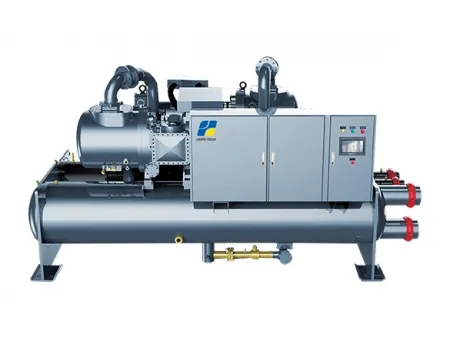
Industrial chiller with falling film evaporator and semi-hermetic twin screw compressor
- Refrigerant: R22/R134A/R507
- Power source: 380V 50Hz 3Ph
- Compressor: semi-hermetic twin screw compressor
- Chilled water temperature range: 7°C to 35°C (adjustable temperature)
- Min. dimensions (L×W×H): 3100×1200×1700mm
Falling film screw chillers are known for delivering strong energy efficiency and dependable cooling, even in demanding conditions. Rather than fully flooding the evaporator, they let the refrigerant form a thin, even film over the heat exchange tubes, flowing gently downward under gravity. This design enhances contact with the tube surface, which in turn improves evaporation, strengthens heat transfer, and lowers the amount of refrigerant needed. In practice, this means they adapt well to processes where temperature precision matters, cooling reaction vessels in chemical plants, keeping fermentation tanks at the right level in breweries, or stabilizing conditions in automotive production lines. They are also widely used in large-scale central air-conditioning systems, district cooling plants, ice storage projects, and similar applications that need efficient cooling and optimized power consumption.
- Efficient Cooling with Noticeable Energy Savings
- Falling-film evaporators distribute the refrigerant in a thin, uniform layer across the tubes.
- The larger the contact surface, the better the heat transfer.
The difference between the evaporating temperature and the chilled water outlet temperature is only 1-2°C, reducing the compressor workload and improving the COP by 10-20% compared to traditional flooded designs. - High performance is maintained even at partial load, making it ideal for applications with fluctuating demands.
- Reduced Refrigerant Requirements
- Falling film screw chillers use 30–50% less refrigerant than a flooded chiller.
- The lower charge reduces the risk of leaks, lowers maintenance costs, and mitigates environmental impact.
- Better Resistance to Fouling
- The constant liquid film flow helps prevent scale buildup on tube surfaces.
This extends cleaning intervals and keeps performance stable, even with poor water quality.
- Consistent and Reliable Operation
- The refrigerant flow is carefully controlled to prevent liquid slugging, a common risk in flooded evaporators. This protects the compressor and ensures long-term stable and trouble-free operation.
- In precision injection molding, keeping temperature fluctuations within ±0.3°C helps achieve flawless thin-walled parts and optical-grade plastics such as PC or PMMA.
- For extruders, steady screw and barrel temperatures prevent heat-sensitive materials like PA or PEEK from breaking down.
- In blow molding operations, rapid preform cooling from the chiller shortens production cycles and increases throughput.
- Reactors rely on accurate temperature control to keep exothermic reactions stable, ensuring both process efficiency and product purity.
- Step-by-step cooling is used in crystallization to produce high-purity compounds or pharmaceuticals.
- High-power lasers need stable operating temperatures to avoid thermal drift and maintain cutting or engraving precision.
- Chip testing environments require reliable chilled water to keep constant temperature and humidity conditions.
- Fermentation tanks run best when temperature is kept in a narrow range, ensuring consistent flavor and quality.
- Quick-freezing lines for ready meals, ice cream, and similar products rely on fast, efficient cooling.
- Large commercial buildings can integrate these chillers into central air-conditioning systems to reduce energy costs.
- Lithium battery production lines use them for temperature-sensitive stages like coating and formation.
| Model | HTSFF- | ||||||||||||
| | | | | | | | | | | | | ||
| Nominal Cooling capacity | kW | 303 | 385 | 521 | 733 | 848 | 992 | 1200 | 1477 | 2076 | 2110 | 2536 | 4153 |
| kcal/h(×104) | 26.3 | 32.6 | 45.2 | 63 | 73.5 | 85.1 | 102.9 | 127.1 | 178.5 | 181.7 | 218.1 | 357.1 | |
| Coefficient of performance (COP) | 6.1 | 6.4 | 6.3 | 6.3 | 6.4 | 6.6 | 6.5 | 6.4 | 6.3 | 6.3 | 6.3 | 6.3 | |
| Refrigerant | R22/R134A/R507 | ||||||||||||
| Power source | 3PH 380V 50HZ | ||||||||||||
| Compressor | Type | Semi-hermetic twin-screw compressor | |||||||||||
| Quantity | 1 set | 2 set | |||||||||||
| Start mode | Y-△ | ||||||||||||
| Capacity control | 3-step,4-step or stepless capacity control | ||||||||||||
| Input power (kW) | 49 | 60 | 83 | 116 | 131 | 150 | 184 | 228 | 329 | 335 | 402 | 652 | |
| Operating current (A) | 83 | 101 | 140 | 195 | 220 | 252 | 310 | 383 | 552 | 562 | 675 | 1095 | |
| Evaporator | Type | High-efficiency shell and tube falling film evaporator | |||||||||||
| Flow (m³/h) | 52 | 66 | 90 | 126 | 145 | 170 | 206 | 254 | 357 | 362 | 436 | 714 | |
| Pipe connection (mm) | DN100 | DN100 | DN100 | DN125 | DN150 | DN150 | DN150 | DN200 | DN200 | DN250 | DN250 | DN300 | |
| Water pressure drop (kPa) | 50 | 50 | 50 | 50 | 50 | 50 | 55 | 55 | 55 | 58 | 58 | 60 | |
| Condenser | Type | Shell and tube | |||||||||||
| Flow (m³/h) | 58 | 73 | 103 | 146 | 162 | 188 | 228 | 281 | 413 | 401 | 505 | 836 | |
| Pipe connection (mm) | DN100 | DN100 | DN125 | DN150 | DN150 | DN150 | DN150 | DN150 | DN200 | DN250 | DN250 | DN300 | |
| Water pressure drop (kPa) | 46 | 46 | 47 | 47 | 48 | 48 | 50 | 50 | 53 | 53 | 56 | 58 | |
| Dimensions | Length (mm) | 3100 | 3100 | 3200 | 3650 | 3700 | 3700 | 3700 | 3750 | 3800 | 4850 | 5400 | 5990 |
| Width (mm) | 1200 | 1200 | 1260 | 1360 | 1550 | 1650 | 1700 | 1700 | 2200 | 2100 | 2050 | 2350 | |
| Height (mm) | 1700 | 1700 | 1850 | 1990 | 2200 | 2250 | 2300 | 2500 | 2850 | 2300 | 2500 | 3050 | |
| Net weight (kg) | 2500 | 2500 | 3100 | 3500 | 3600 | 4000 | 4350 | 5800 | 7200 | 8380 | 11500 | 13550 | |
- Nominal operating condition parameters: The inlet/outlet temperature of chilled water is17 ℃/12℃, and the inlet/outlet temperature of cooling water is 30℃/35℃.
- The evaporator is a high-efficiency shell and tube falling film evaporator, and the condenser is a high-efficiency shell and tube condenser. The designed pressure on the water side for both units is 1.0 MPa.
- Due to technological improvements, the external dimensions and weight may change. Therefore, the above values are provided for reference only.
- Considering the transitional and actual operating conditions, it is recommended that the flow rate of the chilled water pump be 1.2 times the evaporator water flow rate, and the flow rate of the cooling water pump be 1.35 times the condenser water flow rate.
- Falling-film evaporators distribute the refrigerant in a thin, uniform layer across the tubes.
- The larger the contact surface, the better the heat transfer.
The difference between the evaporating temperature and the chilled water outlet temperature is only 1-2°C, reducing the compressor workload and improving the COP by 10-20% compared to traditional flooded designs. - High performance is maintained even at partial load, making it ideal for applications with fluctuating demands.
We customize and deliver industrial chillers and process cooling equipment to match your specifications
How do falling film screw chillers adapt to different condenser requirements?
These chillers are equipped with a high-efficiency shell-and-tube heat exchanger featuring a double-pass design and straight water tubes, making maintenance and cleaning simple. The removable end covers on both sides allow for easy customization, so the condenser can be tailored to match specific project demands.
What is the difference between air-cooled and a water-cooled chillers?
Air-cooled chillers use fans to release heat directly into the surrounding air, making them easier to install and maintain. Water-cooled chillers work with cooling towers, offering greater efficiency in facilities with high cooling demands or located in warmer climates.
Which industries can benefit from your chillers?
Our industrial chillers and temperature control solutions are used across multiple sectors, including plastics manufacturing, food and beverage, chemicals, hydrogen energy, lithium battery production, data centers, HVAC, and district cooling.