Transmission Shaft

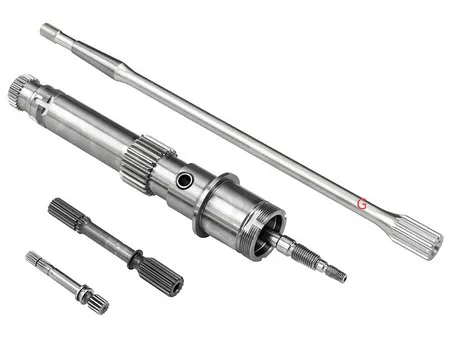
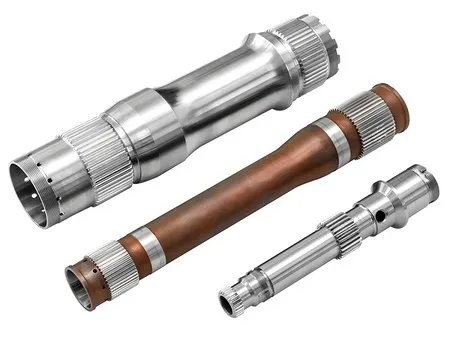

A transmission shaft, also known as a driveshaft or universal joint shaft, is a mechanical component used to transmit torque and rotation. It typically connects parts within a powertrain that cannot be directly linked due to distance or the need for relative motion.
- Module: M0.5-M6
- Length range: ≤1600mm
- Precision: grade 4 (GB11365-89), DIN 4
Low carbon steel, mid-carbon steel, mid-carbon alloy steel, case hardened alloy steel including 20CrMnTi, 20CrMnMo, 20CrNiMo, 18CrNiMo7-6, 17CrNiMo6, 20Cr2Ni4A, 20CrNi2MoA, 18Cr2Ni4WA, 20Cr, 35CrMo, 40Cr, 42CrMo, 40CrNiMo, 40CrNi2MoA, 38CrMoAI, 9310, etc.
These products are designed for aerospace applications, requiring every parameter to undergo full inspection strictly according to drawing specifications. Operating in unique environments, they must adapt to extreme temperature differences. Products must undergo rigorous safety performance testing to ensure that each batch meets destructive testing requirements, thereby fulfilling the allowed safety values.
Materials & heat treatment: Typically utilize special materials such as 9310 and 18Cr2Ni4WA. Various heat treatment methods are employed, including carburizing and quenching, carbonitriding, or nitriding.
These products are generally used in UAV (Unmanned Aerial Vehicle) rotor systems, often referred to as rotor shafts. Given their unique operating environment, the product's weight needs to be minimized as much as possible while meeting performance requirements. This reduction in weight contributes to a lower overall weight for the UAV system, allowing a lighter drone to carry more payload under the same load capacity. Therefore, the design of these products embodies this philosophy from the outset, which significantly increases manufacturing difficulty. Even today, the processing of hollow transmission shafts remains a very challenging task.
Materials & heat treatment: Typically utilize special materials such as 9310, 18Cr2Ni4WA, and 20Cr2Ni4A. Various heat treatment methods are employed, including carburizing and quenching, carbonitriding, or nitriding.
For which industries and equipment have you designed and produced transmission shafts?
Kean has provided transmission shafts for aerospace companies, specifically for helicopter rotor systems or aircraft auxiliary power units, and for port machinery manufacturers, used in container cranes or ship propulsion systems.
What are the common components of a transmission shaft?
The main components typically include a shaft tube, universal joints (u-joints), slip yoke/slip joint, flange yoke, center support bearing, splines, and balance weights.
What are the common types of transmission shafts?
By structure, they can be categorized into solid transmission shafts and hollow transmission shafts. By universal joint type, they can be classified as non-constant velocity universal joint transmission shafts, quasi-constant velocity universal joint transmission shafts, and constant velocity universal joint transmission shafts.
What's the difference between a transmission shaft and a machine shaft?
A machine shaft is a manufacturing component of various devices that does not participate in power supply; a crankshaft is a prime example. In contrast, a transmission shaft acquires power from its origin and distributes it according to the needs of different machine components.
What are the common uses of a transmission shaft with gear?
Common applications for a transmission shaft with integrated gears include:
- In mining equipment and bulk material handling systems, such as industrial reducers.
- In automotive transmission systems, for components like gearboxes and countershafts.
- In the power transmission systems of construction equipment like excavators and bulldozers.
- As power take-off (PTO) shafts in agricultural machinery such as harvesters and planters.