Traction Gas Springs

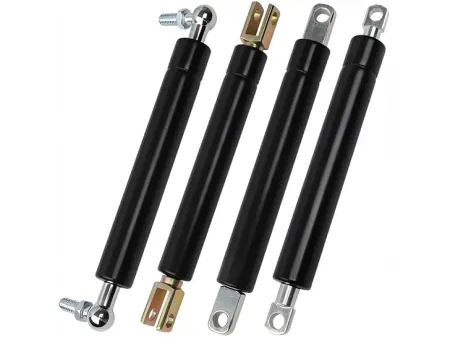

Gas tension springs designed to provide controlled pulling force for controlled motion in industrial, furniture and automotive applications
Saiensi specializes in the research, development, and manufacturing of gas springs and industrial elastic support components. With advanced design capability and a complete production system, Saiensi provides customized solutions based on specific operating conditions. All products undergo strict testing and quality control to ensure stable performance and long service life under high-pressure environments, meeting the diverse demands of automotive, machinery, furniture, and industrial automation applications.
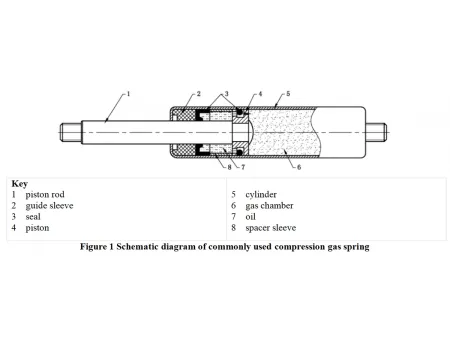
A gas spring is an industrial component designed to provide both support and damping functions. It consists of a cylinder, piston rod, sealing and guide package, and a sealed chamber filled with inert gas or an oil-gas mixture. The operating principle is based on the pressure difference generated between the two sides of the piston, caused by their varying cross-sectional areas. This pressure drives the piston rod to extend smoothly, allowing for steady and controlled motion. Compared to traditional mechanical springs, gas springs feature slower motion speed, smaller dynamic force variation, an almost linear elasticity curve, and smoother operation for improved comfort and precision.
- Piston rod: Alloy steel / Stainless steel / Aluminum alloy, with surface options including hard chrome plating or nitriding (QPQ).
- Cylinder and end fitting: Stainless steel / Alloy steel / Aluminum alloy, with protective alloy plating or coatings (water-based or oil-based paints).
- Piston: Powder metallurgy / Aluminum alloy / Alloy steel, ensuring excellent wear resistance and sealing performance.
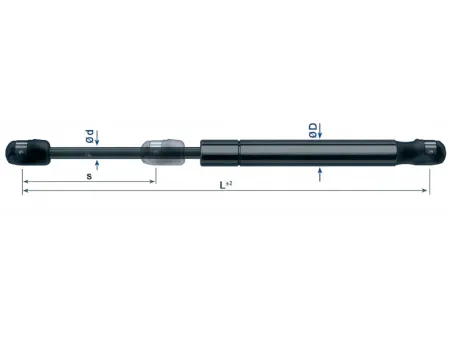
| d(mm) | D(mm) | S(mm) | L(mm) | Force F1(N) |
| 4 | 12 | 20-200 | 115-465 | 5-150 |
| 6 | 15 | 20-200 | 115-465 | 50-400 |
| 8 | 18 | 50-350 | 190-775 | 100-700 |
| 10 | 22 | 40-500 | 170-1090 | 100-1200 |
| 12 | 27 | 100-500 | 270-1120 | 500-1500 |
| 14 | 27 | 100-500 | 270-1120 | 500-2500 |
What advantages do traction gas springs have over traditional mechanical springs?
- Gas springs operate at a slower, more controllable speed with minimal dynamic force variation (elastic coefficient X typically between 1.2 and 1.4).
- Gas springs feature a nearly linear elastic curve, providing smoother and more comfortable motion.