Idlers


Request a Quote
Heavy Equipment Undercarriage Parts
Abnormal wear on the sides of the track links or friction between the idler and the machine frame often suggests misalignment between the track and the idler. Possible causes include: a loose frame, worn side plates on the track, a broken axle, or a malfunctioning tensioning device.
Longer Service Life and Superior Durability
Our Manufacturing Process
- The idler is made from 35SiMn alloy steel, with surface hardness reaching HRC 55–58 and a hardened layer depth of 8–10mm for improved wear resistance.
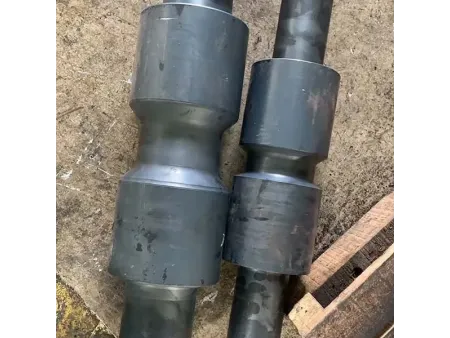
- The shaft is manufactured from 40CrMo, processed through high-precision CNC machining centers with tempering treatment and high-speed polishing, ensuring a smoother surface and enhanced resistance to wear and fracture.
- Each idler is internally lubricated with premium high-performance grease (GL-5W/140), formulated to withstand high temperatures and extreme cold, effectively protecting the bronze bushing, oil seal, and sealing ring from wear and damage.
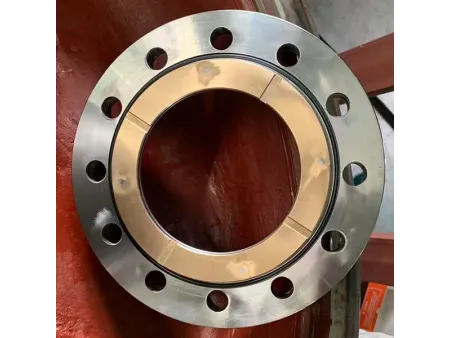
- The bronze bushing offers excellent wear resistance and thermal stability, effectively extending the service life of the component.
- The bushing is made of pure copper with no added impurities, ensuring durability and performance consistency.
- All undercarriage parts are produced strictly according to 1:1 original dimensions, ensuring full compatibility and precise fit with OEM parts.
Common Market Practices
- Many heavy equipment parts on the market use lower-grade materials like 50Mn or 45# steel, which fail to meet wear resistance requirements and are prone to cracking or breaking.
- Some manufacturers apply basic medium-frequency tempering, resulting in rough surfaces and shallow hardness layers, only 0.2mm deep, greatly reducing service life.
- Low-cost lubricants are often used in the market, lacking the required high-temperature resistance, leading to oxidation, viscosity loss, compromised sealing, poor lubrication, and accelerated component failure.
- Powder metallurgy is commonly used as cheaper alternatives, but it falls short in both wear resistance and thermal consistency, making the parts more vulnerable to abrasion.
- Traditional alloy-powder bushings may appear copper-plated but are mostly alloy inside, offering poor durability and higher wear rates.
- In pursuit of lower costs, some suppliers reduce the dimensions of certain components, which leads to overall size reduction and results in poor compatibility or installation failure.
Our Manufacturing Process Showcase
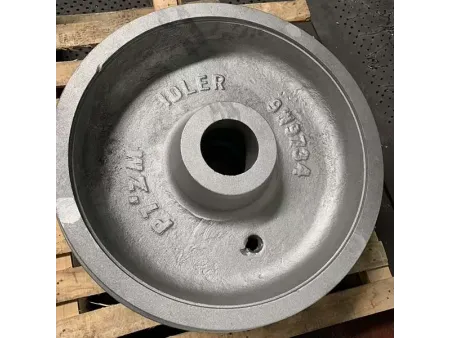
- Precision casting results in a dense wheel body with no air pockets, reducing the risk of air leakage.
- The solid bronze bushing provides excellent wear resistance and stable thermal performance.
- The center shaft undergoes quenching and tempering followed by CNC machining and surface heat treatment, ensuring a smooth finish that prevents damage to internal components during operation, while delivering high hardness and load-bearing strength to prevent breakage.
- During assembly, the interior of the idler must be kept clean and free from dust or debris.
- Each idler is pressure-tested after assembly to ensure there is no air or oil leakage.
- For large-size idlers, we adopt an upright packaging method to ensure product integrity during transport.