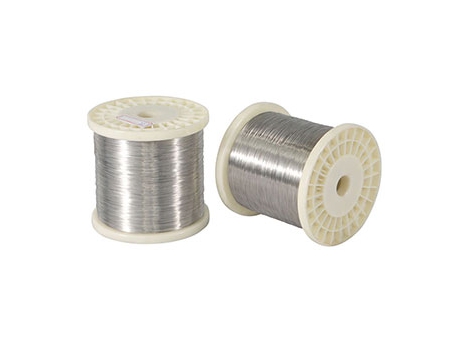
Reliable in oxidizing, inert, and dry reducing atmospheres, Ni-Cr vs. Cu-Ni thermocouple wires ensure stable temperature measurement and can endure short-term vacuum exposure. To maintain performance, it should be shielded from sulfur-containing and highly oxidizing environments. Among standardized thermocouples, it delivers the highest electromotive force (EMF) per degree, making it ideal for precise thermal sensing applications.
Chemical properties (%) | Material | Chemical composition (%) |
| Ni | Cr | Cu | Mn | Al |
| LP(Chromel) | 90 | 10 | | | |
| LN(Copel) | 44 | | Bal | 0.5-1 | |
| Material | Density(g/cm3) | Melting point℃) | Tensile strength(Mpa) | Volume resistivity (μΩNaN) | Elongation rate (%) |
| LP(Chromel) | 8.5 | 1427 | >490 | 70.6(20℃) | >25 |
| LN(Copel) | 8.8 | 1220 | >390 | 49.0(20℃) | >25 |
| Material | EMF value vs. Platinum (μV) |
| | 100℃ | 200℃ | 300℃ | 400℃ | 500℃ | 600℃ | 700℃ | 800℃ | 1000℃ | 1100℃ |
| LP(Chromel) | 6.750~6.970 | 14.436~14.678 | 22.711~22.967 | 31.348~31.628 | 40.116~40.468 | 48.887~49.309 | 57.612~58.100 | 66.200~66.738 | - | - |
| LN(Copel) |