Static Var Generator (SVG), High Voltage

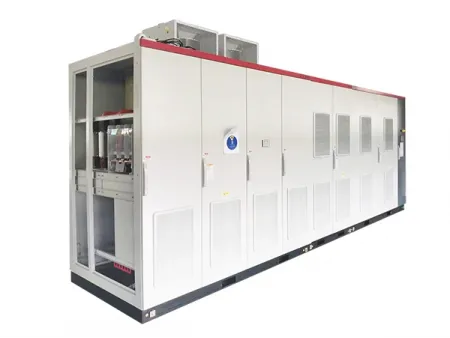
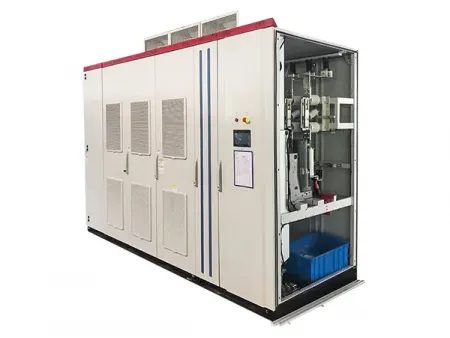
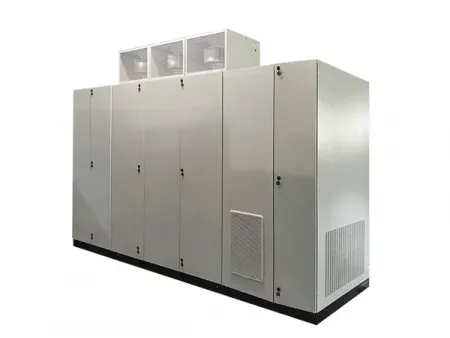

Dynamic reactive power compensation equipment for power quality enhancement and grid stability
- Rated capacity: 100kVAr – 25MVAr (supporting modular expansion)
- Operating voltage: 6kV / 10kV
- Operating frequency: 50 / 60Hz ± 5%
- Connection method: delta connection (Δ), star connection (Y)
- Power factor (compensation accuracy): ≥0.99
- Efficiency (under rated operating conditions): ≥99%
- Operating temperature: operating temperature
- Enclosure: optional according to customer requirements
A high-voltage Static Var Generator (SVG) is a system used for real-time reactive power compensation and power quality improvement. It works by connecting a voltage source inverter (VSI) to the grid through a reactor. The inverter includes a DC capacitor and an inverter bridge made up of IGBT (Insulated Gate Bipolar Transistor) modules, semiconductor switches that precisely control current and voltage. By adjusting how these IGBTs turn on and off, the inverter can control the amplitude and phase of its AC output, allowing the SVG to generate or absorb reactive current as needed.
Unlike traditional reactive compensation equipment, the high-voltage SVG uses a modular multilevel topology and instantaneous reactive power control to function as a variable current source directly connected to the grid. This means it can quickly adjust reactive power in either direction, stabilize voltage, reduce harmonic distortion, and maintain steady operation even when load conditions change suddenly. Through accurate current control, it continuously balances the system’s power factor and helps ensure smooth, reliable, and energy-efficient grid performance.
- High voltage SVGs respond within milliseconds, with reaction times of ≤10 ms (as fast as 1 ms), far faster than traditional devices (40–60 ms). Their rapid action instantly suppresses voltage flicker and fluctuations, effectively improving power quality in applications with heavy impact loads such as arc furnaces and rolling mills.
- Use PWM modulation technology to achieve smooth, bidirectional reactive power regulation from capacitive to inductive modes, avoiding voltage surges caused by stepwise switching in conventional systems.
- Improve overall energy efficiency by increasing the power factor to above 0.95, reducing line and transformer losses, and helping users achieve direct energy savings.
- Free up transformer capacity by minimizing reactive power occupation, enabling the same transformer to carry 15–20% more active load and delaying costly capacity expansion.
- Include active harmonic suppression, keeping total harmonic distortion (THDi) below 3% while simultaneously compensating reactive power and mitigating harmonic interference.
- Feature compact modular construction that requires minimal space and supports flexible capacity expansion for future system upgrades.
- Designed for harsh conditions, with strong vibration resistance up to seismic intensity 8, continuous overvoltage tolerance up to 1.05 times the rated value, and reliable performance in high-altitude or high-temperature environments.
- Equipped with complete protection functions such as overcurrent, short-circuit, overvoltage, undervoltage, and lightning protection, ensuring safe and continuous operation.
- Support multiple communication protocols, including RS485, CAN, Modbus, TCP/IP, and GPRS, enabling intelligent remote monitoring and real-time control of SVG performance.
| General | Product type | Static Var Generator (SVG), High Voltage |
| Rated capacity | 100kVAr – 25MVAr (supporting modular expansion) | |
| Operating voltage | Selectable 1. 6kV 2. 10kV | |
| Power factor | -1 to 1 | |
| Operating frequency | 50/60Hz±5% | |
| Connection method | Selectable 1. Delta Connection (Δ) 2. Star Connection (Y) | |
| Wiring method | Three-phase, three-wire | |
| Performance | Parallel operation | Ring network |
| Cooling method | Selectable 1. Natural air cooling (AN) 2. Forced air cooling (AF) | |
| Output current harmonic distortion (THD) | ≤3% (compatible with PWM modulation filtering) | |
| Dynamic response capability | Response time (capacitive and inductive: 0–25M): ≤5ms Real-time compensation capability up to ≤10ms | |
| Power factor (compensation accuracy) | ≥0.99 | |
| Efficiency (under rated operating conditions) | ≥99% | |
| Overload tolerance | 1.2 times rated capacity (continuous operation for ≥1 minute) | |
| Protection functions | Self-diagnosis and multiple protection features including over-voltage, under-voltage, frequency anomaly, over-temperature, over-current, short-circuit, phase-loss, DC bus over-voltage, DC bus under-voltage, IGBT fault, and inverter bridge reverse protection | |
| Control functions | Selectable 1. Reactive power compensation 2. Voltage compensation 3. Harmonic compensation 4. Unbalance compensation 5. Flicker suppression | |
| Redundancy design | Supporting modular N 1 redundancy for power units | |
| Operating environment | Human-machine interface | Selectable 1. Real-time and fault waveform recording 2. 16-channel oscilloscope function 3. Phase sequence adaptive control |
| Communication port | RS 485, CAN, Ethernet, GPRS | |
| Communication protocol | Modbus-RTU, Profibus, CDT91, IEC104 | |
| Monitoring method | Selectable 1. Independent module monitoring 2. Centralized module monitoring | |
| Operating temperature | -10℃ to 40℃ | |
| Relative humidity | ≤95%, non-condensing, no dew formation | |
| Altitude | ≤1000m (customized design required for higher altitude) | |
| Enclosure | Optional according to customer requirements 1. Indoor type 2. Outdoor type (supporting IP54 protection and seismic design) | |
| Standards compliance | Wind power load | GB/T 19963-2011 |
| Photovoltaic load | GB/T 19964-2012 |
- Long-Distance Power Transmission Systems
- Coal Mine Power Networks
- Traction Substations for Rail Transit
- Intermediate-Frequency Furnaces
- Electric Arc Furnaces
- Renewable Energy Grid-Connected Sites
For high-voltage power grids (such as metallurgical arc furnaces) with large reactive power fluctuations and unstable voltage, which solution should be selected?
High-voltage Static Var Generators (SVG) are the best option as they provide real-time dynamic compensation for rapidly changing reactive power (response time < 100 ms), stabilizing grid voltage and supporting highly fluctuating loads.
Can a high-voltage SVG operate effectively in weak or remote grids with frequent voltage drops?
Yes. High-voltage SVGs can provide continuous voltage support even under weak grid conditions. By injecting or absorbing reactive power as needed, they help maintain voltage stability, improve power factor, and prevent system instability caused by sudden load variations or line impedance.