Hydraulic Forging Presses

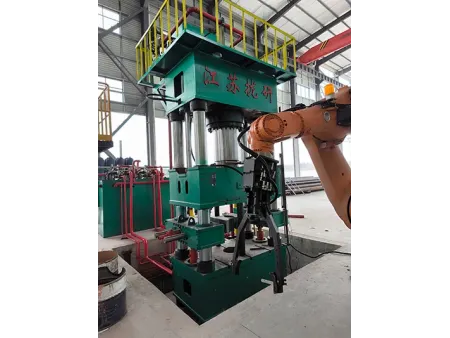
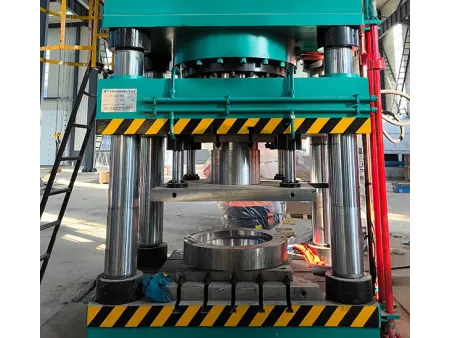
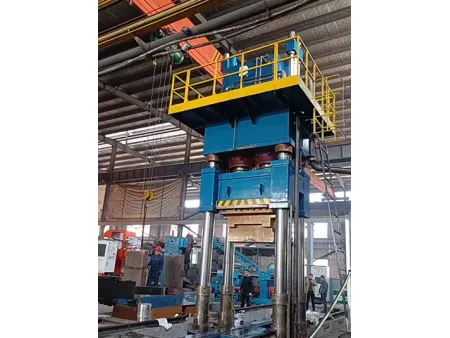

Hydraulic forging presses are machines that utilize hydrostatic liquid pressure for metal forging. They are commonly used for free forging processes such as upsetting, piercing, mandrel hole expansion, offsetting, twisting, cutting, bending, and drawing. These products are widely applicable, capable of pressing various workpieces. In ring rolling, they perform initial pressing and piercing operations. A full range of tonnages is available, from 100-ton to 30,000-ton forging presses, meeting the customized needs of clients across different fields.
Requires the use of molds. Pressure is applied to the metal blank through the molds to shape it within the mold cavity. This type offers high production efficiency and high dimensional accuracy for forgings, suitable for mass production of uniform specification forgings.
Does not require molds and can perform free forging on metal billets. It offers high flexibility, making it suitable for single-piece or small-batch production and the processing of large forgings.
Replaces air hammers and is ideal for forging smaller components.
Suitable for materials with narrow forging temperature ranges, such as titanium alloys and stainless steel.
- Available in four-column and frame structures, providing comprehensive support and rigidity during forging operations.
- Employs PLC controllers for automated control, providing large forging forces up to 30,000 tons to forge large, high-strength metal components.
- Ensures dimensional and shape accuracy of forgings through controlled pressure systems and molds.
- Capable of forging components of various shapes and sizes, advantageous for processing complex-shaped forgings.
- Uses electrical and hydraulic systems for automated operations, improving productivity and product quality.
- Hydraulic systems operate smoothly with low impact and vibration, minimizing equipment and mold damage and reducing noise pollution.
- High-quality materials such as 5CrNiMo and 42CrMo are used for key components, suitable for forging high-strength alloy workpieces.
- Advanced sensor technology, computer controls, and artificial intelligence allow automated and intelligent control, including automatic loading/unloading, automatic mold change, fault diagnosis, and early warning.
- Adopts efficient hydraulic systems and energy-saving motors, using environmentally friendly hydraulic oil and lubricants to reduce energy consumption and meet environmental standards.